
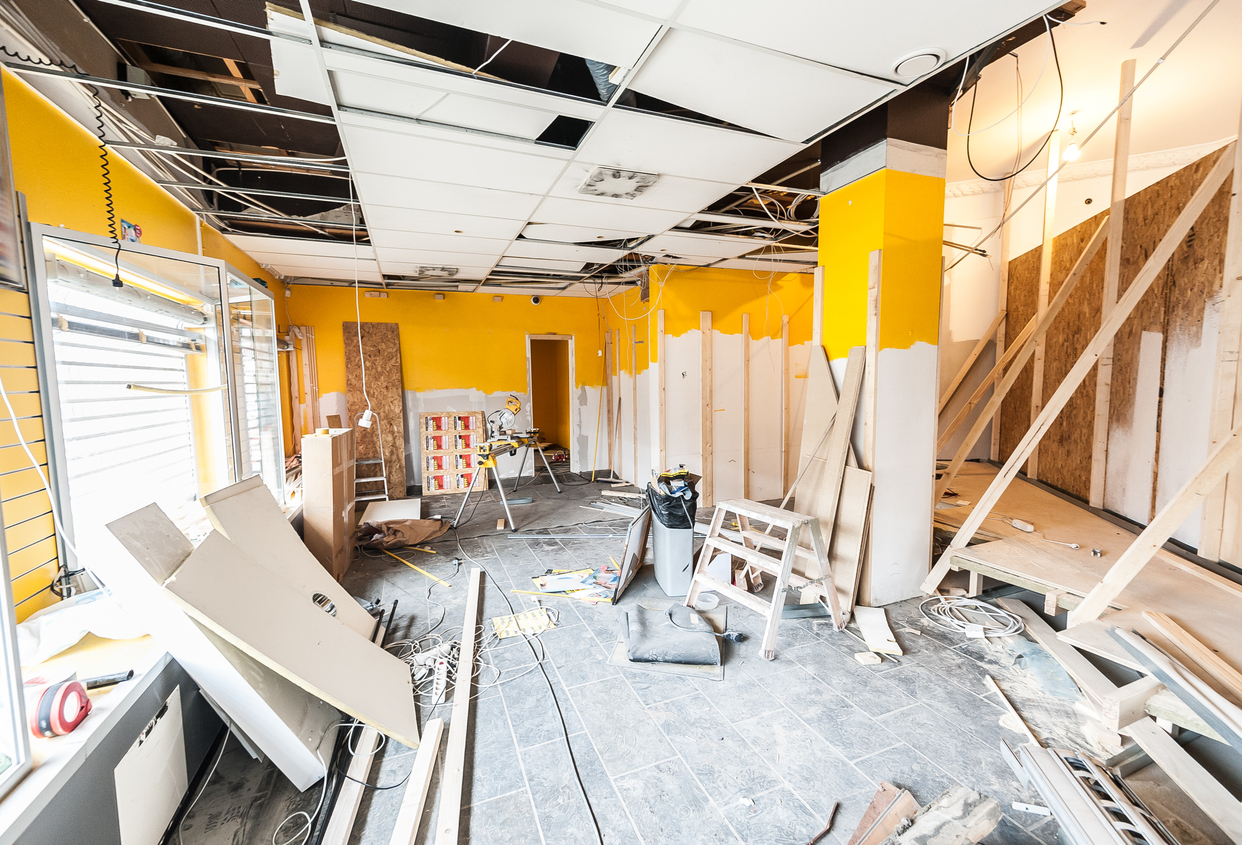
An occupied store changes the liability exposures on a renovation job. Shoppers and store employees keep moving through the space, merchandise stays on the shelves, and the contractor has to work around both. A cord stretched across an aisle or dust settling on a rack of clothing can turn into a third-party claim against the contractor. Commercial general liability (CGL) insurance may respond to claims alleging bodily injury or property damage, subject to the policy’s terms, and brokers who understand how the job runs can place coverage that fits it.
What General Liability Risks Arise During Retail Renovations?
Customers don’t read site plans. A shopper heading for the fitting rooms may cut past a partially closed aisle or catch a foot on a pallet of flooring waiting to go down. Loose debris, tools left at the edge of a work area, and temporary partitions that block a familiar route all put the public in direct contact with construction activity.
The store’s property sits inches from the work, too. A sanding crew might coat a display of handbags in dust, a dropped light fixture may crack a glass case, and a loaded drywall cart could gouge flooring outside the work zone. The retailer or landlord will look to the contractor to pay for those losses, and coverage depends on where the damage happened.
The standard CGL form’s damage-to-property exclusion removes coverage for “that particular part” of real property the contractor is working on, and courts disagree on how far that phrase reaches. Damage to merchandise outside the work area raises a different question from damage to the floor the crew is replacing, and the policy wording will decide both.
Subcontractors add exposure that the managing contractor still carries. An electrician might leave a junction box open overnight, or a flooring sub might stage materials in an aisle the general contractor had just cleared. If a customer gets hurt, the claim can name the contractor running the project, whether or not its own crew caused the problem.
How Does an Active Retail Environment Affect Liability Exposure?
On an occupied retail job, a third-party claim can start the moment a shopper or a piece of merchandise crosses into the work area. The National Institute for Occupational Safety and Health (NIOSH) addresses that boundary in its guidance on construction and renovation in occupied buildings, which recommends:
- Isolating work areas with physical barriers
- Routing construction traffic through unoccupied areas
- Bagging debris for prompt removal
Each practice gives customers fewer openings to wander into the work zone and keeps dust and debris away from merchandise on the sales floor.
The same NIOSH publication recommends scheduling work during periods of low occupancy when possible. For a retailer, a low-occupancy schedule might put demolition before the doors open and shift dusty tasks to slower weekdays. Contractors should also settle delivery windows, entry points, and work hours with store management before the job starts. Those agreements keep supply trucks and material carts away from the entrances and aisles customers use.
What Should Brokers Review Before Requesting a Premium Indication?
A complete general liability submission gives the underwriter a clear picture of the operation and can save a round of follow-up questions. For a retail renovation contractor, the submission should explain the scope of work, how the store will operate during the project, and how coverage lines up with the contract.
Describe the Contractor’s Operations
Describe the operation in detail, including subcontractor usage and responsibilities. For a retail renovation contractor, “commercial remodeling” omits key details. Describe the work performed, the classifications involved, a typical project’s scope, and which tasks subcontractors handle.
Ask How the Store Will Operate During the Work
Find out whether the store will stay open during the work and how the contractor will keep customers away from active areas. Ask who maintains the partitions and walkways. Identify the merchandise, fixtures, and finishes near the work, and whether the contractor will cover, contain, or relocate them.
Compare Coverage With Contract Requirements
Compare limits with the requirements in the construction contract or lease, and review exclusions that affect work in occupied commercial space. Retailers and landlords may both require additional insured status. Address completed operations as well, since an injury from a poorly anchored display fixture can surface weeks after the store reopens.
A program like the one Commodore offers includes blanket additional insured coverage for ongoing operations, with an additional insured endorsement for completed operations available on commercial work.
Review Retail Renovation Risks With Commodore
When a store remains open during a renovation, customers and inventory are in close proximity to active construction. How well the contractor separates the work zone from the store shapes its CGL needs. Contact Commodore to talk through your contractor clients’ retail renovation operations and obtain a premium indication.
About Commodore
Commodore Insurance Services, Inc. (Commodore) is a California corporation that operates as a Managing General Agency and Program Manager. Since incorporating in 1990, Commodore has developed an expertise in the production and underwriting of insurance products for businesses across the West Coast. Our focus is on providing top-level insurance products to our clients while striving to make it easy to do business for our brokers. Try us and find out why we have continued to be successful for more than 27 years and are recognized as the trusted leader in small business insurance.